

The world of online search seems to be changing faster than ever, thanks to the widespread use of artificial intelligence. And AI isn’t just shaping what people find online … it’s shaping how they find it.
For businesses and brands, staying visible means adapting quickly. While great content and SEO fundamentals still matter, new AI tools for SEO are making it easier to analyze performance and optimize your content for strong search rankings.
Here’s how marketers can use AI tools for SEO to sharpen their strategy and stay competitive as search continues to evolve.
AI Tools for SEO That Are Changing How Marketers Work
AI-powered SEO platforms now handle everything from content optimization to technical analysis and keyword research … all in a fraction of the time it once took.
A few tools leading the charge include:
Semrush
A full-suite SEO powerhouse for tracking rankings, performing competitive analysis, optimizing content, and now integrating AI-powered recommendations to enhance GEO (Generative Engine Optimization) strategies.
Surfer SEO
Helps identify keyword opportunities and optimize content structure based on data from top-ranking pages.
Clearscope
Uses AI to analyze high-performing content and suggest keyword enhancements for improved visibility.
Alli AI
Automates on-page optimization and technical SEO fixes directly across websites.
SERP Gap
Reveals gaps between your site and competitors in search results, using AI-driven insights to highlight missed keyword or content opportunities.
AnswerThePublic
Surfaces the exact questions people are asking online so you can shape content that aligns with real user intent and AI-driven search trends.
ChatGPT
While not an SEO tool itself, it can be invaluable for drafting metadata, brainstorming keyword-rich topics, or generating content outlines aligned with your strategy.
No matter your pain points when it comes to optimizing your content for search, there’s a tool out there for you to help make your process a little less manual … so you can get back to strategy instead of doing spreadsheet gymnastics.
Our Favorite AI Tool for SEO: Semrush
For many marketing teams (including ours) Semrush is the current tool of choice. It combines deep analytics with AI-powered insights that help marketers uncover hidden opportunities across both traditional search and generative AI platforms. (Full disclosure: We are a certified agency partner)
Here are a few ways Semrush is using AI to innovate — expanding its tools, deepening its insights, and helping marketers strategize for an AI-driven search landscape:
- Evolved Keyword Intelligence: AI now helps group and predict high-impact keyword clusters based on real search intent — not just volume. That means less guesswork and more focus on the phrases that will actually drive conversions.
- Smarter Content Optimization: Semrush’s SEO Writing Assistant uses machine learning to analyze readability, tone, and search alignment — helping writers produce stronger, search-friendly content faster.
- Competitor Analysis in Context: AI models analyze not just who your competitors are, but how they’re winning — surfacing insights about structure, backlink strategy, and topical authority.
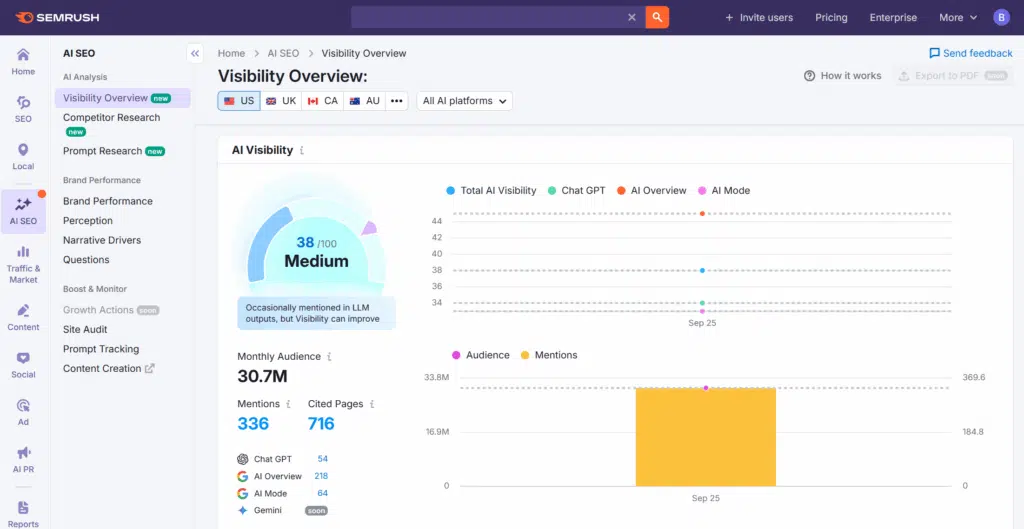
- Tracking AI Visibility: As AI-driven search experiences (like Google’s AI Overviews or ChatGPT responses) become more common, SEMrush’s advanced analytics help monitor how your brand appears and performs within these evolving ecosystems. This particular tool just launched in September 2025, and we’re excited to continue monitoring our clients’ performance over time.
How AI Tools for SEO Fit Into Generative Engine Optimization (GEO)
Generative Engine Optimization (GEO) takes traditional SEO a step further — optimizing not just for search engines, but for the AI systems that increasingly shape how people discover information.
Using tools like Semrush or AnswerThePublic, marketers can identify the kinds of questions, topics, and structures that resonate with both search algorithms and generative models. These insights can help you:
- Structure content in ways AI can easily interpret and surface
- Refine metadata and formatting for stronger visibility in AI-driven results
- Build the authority signals that large language models favor when generating responses
As AI-assisted discovery becomes the norm, the line between SEO and GEO is blurring. Search visibility is no longer just about ranking well … it’s about being recognized and cited as a trusted source across emerging AI ecosystems.
Marketers who use AI tools for search discovery strategically bridge both worlds: optimizing content for traditional search while building the authority that earns placement in generative results.
Remember … Your Search Strategy Still Matters in an AI-Optimized World
AI tools for SEO can identify keywords and analyze rankings, but they can’t define what success actually looks like for your brand. They predict what might perform well based on data patterns … not necessarily what will genuinely connect with your audience or align with your business goals.
That’s why humans are still the backbone of great search discovery. AI can highlight opportunities, but it takes a greater search strategy to decide which ones fit your positioning. It can suggest optimizations, but it takes experience to know when “best practice” conflicts with brand voice or user intent.
Without that human layer, even the most advanced AI tools risk producing content that’s technically optimized but strategically empty. When marketers use AI as an assistant — not a substitute — they gain the speed and scale of automation without losing the judgment and creativity that drive meaningful visibility.
In other words, AI shouldn’t be your strategy. AI is just the tool to help make your strategy work harder.
Ready to Level Up Your Search Strategy with AI?
At Sparkcade, we help teams connect the dots between AI, SEO, and GEO — building strategies that are as human as they are data-driven.
Whether you’re refining your content, exploring new visibility opportunities, or just trying to make sense of how AI fits into your marketing mix, we can help.
Let’s talk about how to put AI tools to work for your search discovery efforts — so you can spend less time guessing, and more time growing.
Leave A Comment